Beyond Cost: What US Companies Should Look for in an Offshore Technology Partner
For many US companies, the first conversation about offshore software development begins with cost. The assumption is understandable. Development teams in other markets can often offer experienced technical capability at a more competitive rate than an equivalent team in the United States, particularly when a business needs to assemble several disciplines across product strategy, user experience, development, quality assurance and project management.
The problem is that the hourly rate is one of the easiest things to compare and one of the least reliable ways to predict whether a software project will succeed.
A development company can look exceptionally cost-effective in a proposal and become extraordinarily expensive once missed deadlines, communication problems, weak architecture, technical debt and rebuilding are taken into account. A more experienced partner may appear more expensive initially, while ultimately saving the client months of lost time, significant development costs and the commercial consequences of launching late or not launching at all.
The real question is therefore not simply whether offshore development can reduce costs. It is whether the offshore team can provide the communication, strategic thinking, engineering quality, stability, transparency and long-term commitment required to become a dependable extension of the client’s business.
That distinction matters because many companies do not just need someone to build software. They need a technology partner who can help them make better decisions before, during and long after the initial development project.
Offshore Development Should Be About More Than Lower Costs
There is nothing wrong with expecting offshore development to deliver commercial value. Cost efficiency is one of the reasons companies consider it in the first place. However, there is an important difference between paying less for an equivalent level of experience and choosing the lowest-priced supplier regardless of the risk.
A software platform is rarely a simple commodity. It may become the primary way a business generates revenue, delivers its service, manages its operations or interacts with customers. A booking platform, SaaS product, customer portal or subscription application can quickly become central to the entire company.
When that is the case, the true cost of development includes far more than the amount shown on an invoice. It includes the quality of the decisions made, the reliability of the delivery process, the ease with which the platform can be maintained and the speed at which the business can respond when requirements change.
It also includes opportunity cost. Every month that a product remains unfinished may mean lost revenue, delayed investment, disappointed customers and competitors gaining ground.
The best offshore relationship is not the one with the lowest hourly rate. It is the one that gives the business the strongest overall outcome for the investment it is making.
Why US Companies Are Often Cautious About Offshore Development
US companies are right to approach offshore development carefully. There are highly capable teams across the world, but there are also development suppliers whose sales promises do not match their delivery capability (we’ve seen this first hand through projects and clients we’ve inherited).
Some businesses have experienced projects being sold by a senior team and quietly handed to inexperienced developers. Others have discovered that the supplier presented itself as a cohesive agency while subcontracting most of the work to freelancers or another offshore company.
Communication can become inconsistent. Deadlines may move without adequate explanation. Quality issues may only become visible towards the end of the project, when correcting them is most expensive. In some cases, the client has limited access to the work in progress and little understanding of whether the platform is genuinely close to completion.
There are also practical questions around business continuity. What happens when a key developer leaves? Where is the project knowledge stored? Can another team member take over? Is the company financially and operationally stable enough to support the platform several years after launch?
These concerns should not be dismissed as outdated assumptions about offshore development. They are legitimate commercial questions that should be answered before a supplier is appointed.
The mistake is not choosing an offshore partner. The mistake is choosing one without understanding how the company operates, who will perform the work and how it protects the client from delivery risk.
Do You Need a Development Supplier or a Technology Partner?

One of the most important questions a company can ask at the beginning of a project is whether it simply needs development capacity or whether it needs broader technical leadership.
A development supplier is typically brought in once the important decisions have already been made. The client provides a specification, a list of features or a backlog of work, and the supplier is responsible for delivering it.
That model can work well when the client already has experienced technical and product leadership internally. A capable CTO, Head of Product or engineering lead may already have defined the architecture, requirements, delivery approach and technical standards.
Many businesses, however, do not have that level of technical expertise in-house. A founder may know the market and customer problem extremely well without knowing how the platform should be structured. An operations team may understand exactly where manual processes are creating inefficiency without knowing which technology should replace them. A corporate innovation team may have a strong business case but limited experience turning an idea into a secure, scalable and usable digital product.
In those situations, simply giving a development company a list of features can be dangerous. The client may be making expensive decisions without having the technical knowledge required to evaluate them.
A technology partner contributes before the brief is finalised. They help the client define the problem, investigate the users, challenge assumptions, shape the MVP, select an appropriate technical approach and identify risks that a non-technical team may not know to consider.
They are not only responsible for building the platform correctly. They help the business decide whether it is building the right platform in the first place.
Bring the Technology Partner in Before Development Begins
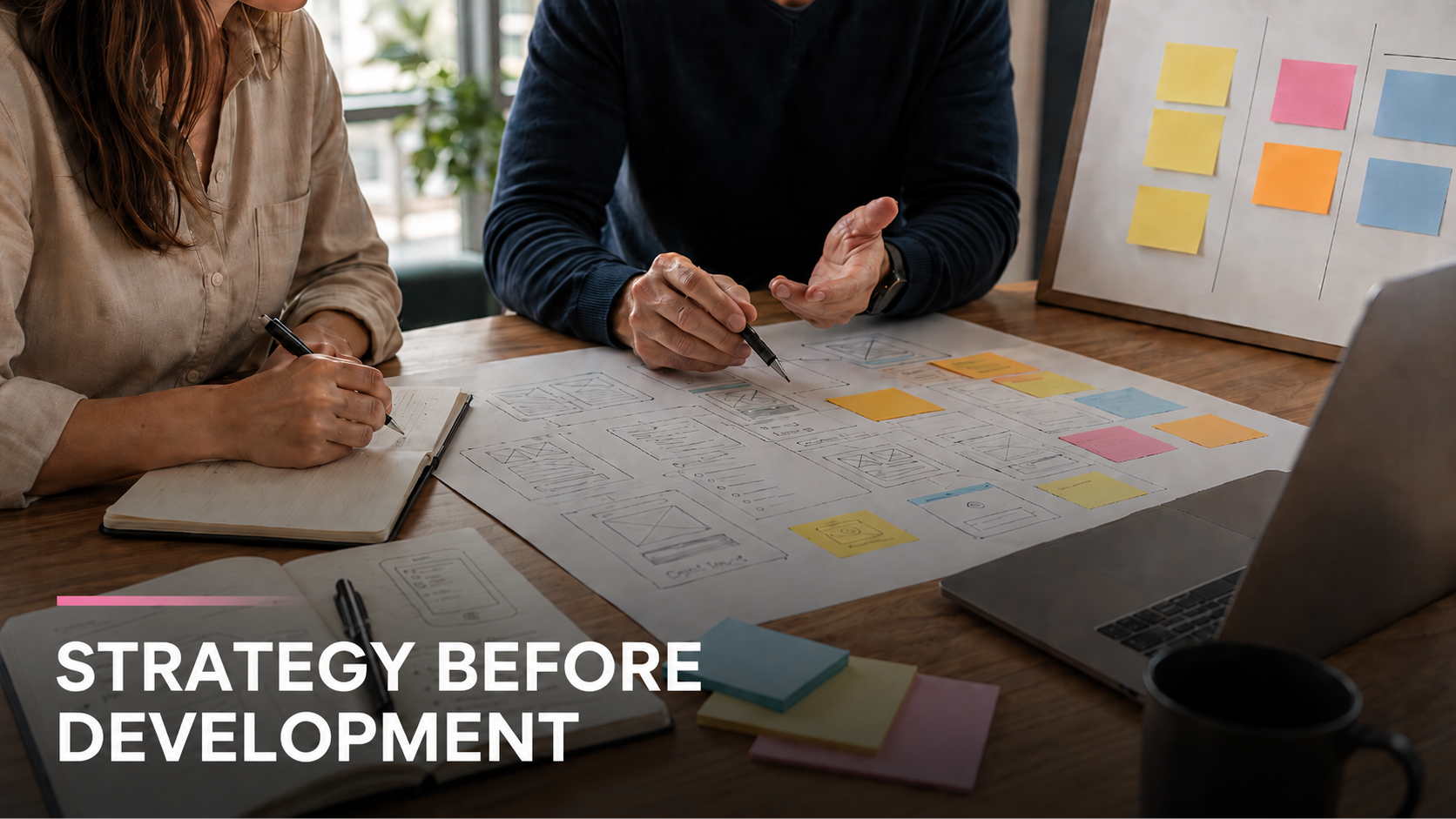
By the time development starts, many of the decisions that determine a project’s success have already been made.
The scope has been defined. Features have been prioritised. User journeys have been mapped. Integrations have been selected. Assumptions have been made about scalability, security, data, infrastructure and future growth.
If those decisions are weak, even excellent developers may end up delivering the wrong product efficiently.
This is why an experienced technology partner should be involved during the early consulting and Discovery stages. The purpose of Discovery is not to create additional paperwork before development. It is to reduce the likelihood that the business spends months building functionality that does not support the product’s commercial goals.
A good partner should be able to advise on product strategy, MVP definition, technical architecture, user experience, integrations, data structures, security, delivery planning and future scalability. They should help the client understand which decisions need to be made immediately and which can be postponed until the product has been validated.
They should also consider the implications that are easy to overlook. Will the platform need to integrate with external systems later? Will the chosen architecture become unnecessarily expensive as usage increases? Does the business need a mobile app, or would a responsive web application be the better first step? How will customer data be protected? What reporting will the business eventually need? What happens after launch?
The best time to solve an expensive development problem is before it becomes a development problem.
A Valuable Partner Will Challenge Your Assumptions
A supplier that agrees with every request may appear easy to work with, but agreement is not the same as expertise.
A technology partner should be prepared to challenge a client when a proposed feature, platform or technical approach does not support the broader business objective. That challenge should be constructive and grounded in experience, but it should still be clear.
We encountered this when a client approached us to develop a self-improvement and personal management product. The client initially wanted a mobile application to be the primary platform. A mobile app may have sounded like the natural format, but once we considered the MVP, target users and product goals, we did not believe it was the right place to start.
A web-first platform could be developed more quickly and at a lower initial cost. Users would not need to visit an app store, download the application and complete an installation before experiencing the product. They could access it immediately from a desktop computer, tablet or mobile device.
Most importantly, the client could validate the product and its core proposition before investing in a dedicated mobile application.
We did not rule out mobile development permanently. We recommended returning to it once the product had gained traction, users were requesting a mobile experience and there was stronger evidence that the additional investment would create value.
That recommendation resulted in a smaller initial engagement for us, but it was the right decision for the client. A technology partner should optimise for the client’s outcome, not for the size of the first development proposal.
An MVP Must Prove One Compelling Proposition
The same principle applies when defining an MVP.
We regularly challenge products that attempt to solve two or more distinct problems in the first release. Founders often feel that including more features will make the product more valuable. In practice, a broad MVP can make it far more difficult to understand whether the product is succeeding.
A focused MVP should test one clear proposition. It should give a specific group of users a compelling reason to adopt the product and provide the business with enough evidence to decide what should happen next.
When an MVP tries to serve too many audiences, solve unrelated problems or introduce several revenue models at once, the scope expands rapidly. Development takes longer, costs increase and user feedback becomes harder to interpret.
If users do not adopt the product, the business may not know which part of the proposition failed. If users do adopt it, the business may still struggle to understand which feature created the value.
An experienced partner should therefore be willing to question the scope, remove functionality and help the client identify the product’s strongest unique proposition. A smaller, more focused MVP is not a reduced version of the vision. It is a more disciplined way to prove that the vision deserves further investment.
Communication Must Survive the Distance

Communication is often described as a soft skill, but in offshore software development it has a direct impact on delivery, budget and risk.
A strong offshore team must do more than speak English. They need to explain technical concepts clearly, document decisions, raise concerns early and communicate progress in a way that gives both technical and non-technical stakeholders confidence.
They should ask questions when requirements are unclear rather than making assumptions. They should explain the implications of a decision rather than simply confirming that it can be built. When a deadline is under pressure, they should say so early enough for the client to respond.
Communication becomes particularly important when the news is uncomfortable. Almost every supplier communicates well while a project is going according to plan. The real test is whether they remain open when a feature is taking longer than expected, an integration is more complex than anticipated or a technical decision needs to be reconsidered.
Silence does not make a problem smaller. It only delays the point at which the client can help solve it.
For US companies working with an offshore partner, communication should be structured rather than left to chance. There should be agreed meeting windows, reporting processes, escalation routes and clear responsibility for decisions. The client should always know who to contact, what has been completed and what may affect the next stage of delivery.
Time-Zone Alignment for US East Coast Teams
Time-zone differences are often presented as either a major offshore disadvantage or an automatic benefit. The reality depends on the countries involved and how the relationship is managed.
For South African teams working with US East Coast clients, there is a practical daily overlap. Meetings can take place at the beginning of the client’s day and towards the end of the South African team’s day.
This window works well for stand-ups, sprint planning, demonstrations, technical discussions, approvals and stakeholder feedback. Both teams can speak directly on the same day rather than relying entirely on asynchronous messages.
The overlap is not identical to working with a local team, and it would be misleading to suggest that South Africa currently provides the same convenience for every US time zone. For East Coast businesses, however, the working relationship can be highly effective when meeting windows and escalation procedures are agreed in advance.
The time difference can also create a useful delivery rhythm. The South African team can make progress before the US client begins its day, meet during the shared window and continue preparing for the next cycle of work.
Time zones become a problem when communication is reactive. When collaboration is structured, the difference can become part of an efficient working model.
Engineering Quality Must Extend Beyond Launch
One of the difficulties clients face when evaluating development partners is that poor engineering can remain hidden for a long time.
A platform may look polished during a demonstration. The screens may work, the basic user journeys may be complete and the client may believe that the product is nearly ready. Problems often emerge later, when usage increases, new features are added or another development team needs to maintain the code.
Engineering quality includes architecture, performance, maintainability, security, documentation, testing and the ability to extend the platform without repeatedly rebuilding earlier work.
A good partner should make technical decisions based on the stage and needs of the product. They should not introduce complexity simply because a technology is fashionable or because the architecture looks impressive in a diagram.
They should also test throughout development rather than treating quality assurance as a final check before launch. By the time a major structural problem is discovered at the end of a project, the cost of correcting it may be substantial.
The real quality of a software platform is revealed by how well it continues to work as the business changes around it.
When the Lowest Proposal Creates the Greatest Business Risk
We once inherited a mobile application that had been under development with a low-cost offshore provider. On paper, the arrangement appeared commercially attractive. In practice, the client spent months dealing with problematic communication, repeated promises and deadlines that were not met.
As the project continued, concerns about quality became increasingly serious. The client was also running out of investor funding and needed to launch the platform to begin generating revenue. The company’s future depended on reaching the market, but the existing delivery record provided little confidence that the supplier could complete the application successfully.
The client had to make a difficult decision. Remaining with the existing provider avoided the immediate disruption of changing teams, but it also meant continuing with a supplier that had repeatedly failed to deliver. Moving the project created additional short-term cost and required a new team to understand work that had already been completed.
After a detailed assessment, the client concluded that staying with the current provider placed the business at greater risk.
We moved quickly because the project was under considerable time and investor pressure. We rebuilt most of the mobile application, made significant changes to the back end, added missing modules and improved functionality that had already been developed. We also refreshed the user experience and reworked important user journeys to make the application more intuitive.
The platform was eventually launched successfully, but the client had already paid a high price in lost time, additional development and commercial uncertainty.
A low hourly rate does not guarantee a low project cost. Missed revenue, delayed market entry, rebuilding, investor pressure and the cost of changing teams can quickly exceed the savings offered by the original proposal.
Appropriate Architecture Is Better Than Impressive Complexity
One of the major problems we found in the inherited mobile application was that the architecture had been over-engineered.
The platform relied heavily on external services and microservices that were not justified by the product’s stage or immediate requirements. While that structure may have appeared technically sophisticated, it created unnecessary complexity and would have introduced substantial costs as the platform scaled.
Microservices can be highly appropriate for certain products, particularly when independent services need to scale separately or when large engineering teams require clear boundaries between systems. They are not automatically the correct answer for every startup or MVP.
Unnecessary complexity introduces more points of failure, more difficult deployments, higher infrastructure costs and a greater maintenance burden. It also makes future development harder because new team members need to understand several moving parts before making changes safely.
We simplified the architecture so that it was more appropriate for the product, its resources and its growth expectations.
Good architecture is not the architecture with the most components. It is the architecture that supports the business without creating complexity the business does not yet need.
Is the Team Genuinely In-House?
One of the questions US prospects have raised with us is whether the people presented by the development company are genuinely part of the team.
This matters because some suppliers sell projects using experienced consultants and account managers before distributing the work to freelancers, temporary contractors or another development company. The client may have very little visibility into who is writing the code or whether the same people will remain involved throughout the project.
An in-house team creates clearer accountability. Team members work within shared processes, technical standards and quality expectations. Project managers, developers, designers and testers are more familiar with how one another work, and knowledge can be distributed across the company rather than remaining with isolated individuals.
Clients should ask directly whether any work will be subcontracted, whether the developers are permanent employees and whether the team introduced during the sales process will actually work on the account.
They should also understand what happens when a team member becomes unavailable. Even an established company will experience staff changes over time. The difference lies in whether the supplier has systems that allow the project to continue without losing critical knowledge.
The strength of an offshore partner should exist within the company, not only within one impressive person introduced during the proposal process.
Transparency Should Leave the Client Informed and in Control
A client should never need to wait until launch to discover what has been built.
Throughout a project, the client should be able to see the platform taking shape, review completed work, test functionality and understand whether delivery is progressing as expected. Transparency is not only about producing a report. It is about giving the client enough visibility to make informed decisions.
At Elemental, this includes sprint planning, regular demonstrations, access to testing and staging environments, reporting and project documentation. As much as we can reasonably share, we share.
The objective is to make the client feel empowered and in control of the project, while still knowing that the delivery team is taking ownership of the work. Those ideas are not contradictory. A strong partner can own the delivery while giving the client full visibility into what is happening.
Transparent delivery also makes it easier to identify misunderstandings early. A client can see whether a feature reflects the intended requirement before several dependent features are built around it. Stakeholders can give feedback while there is still time to respond efficiently.
Visibility creates confidence, but it also creates better products because decisions are made with real information rather than assumptions.
Protecting the Project From Key-Person Dependency
Every software project accumulates knowledge.
Developers learn how the platform is structured, why certain decisions were made, where integrations are fragile and which parts of the system require particular care. Product managers understand stakeholder priorities and the history behind the roadmap. Designers know which user journeys were tested and which alternatives were rejected.
If that knowledge is held by one person, the client is exposed.
A dependable technology partner should use centralised systems, processes and documentation so that knowledge can be stored and shared. This allows new team members to be onboarded efficiently and reduces the disruption caused when someone is unavailable or leaves the company.
At Elemental, we use internal systems, structured processes and shared documentation to ensure that project knowledge belongs to the team rather than sitting only in individual heads.
This does not remove every risk, but it significantly improves business continuity. It also allows a platform to evolve over many years without each new person needing to rediscover the entire history of the project.
Clients should not only ask who knows their platform today. They should ask how the partner ensures that knowledge will still exist tomorrow.
Does the Partner Understand AI, or Merely Talk About It?
Artificial intelligence has become an unavoidable part of technology strategy, but the quality of the conversation varies considerably.
A modern technology partner should understand how AI can improve software products and internal business processes. They should also understand its limitations, risks and the circumstances in which it adds complexity without delivering enough value.
We recently recommended an AI feature for a PropTech platform that allows users to upload images containing information that would otherwise need to be captured manually. AI reviews and analyses the uploaded images and uses the extracted information to pre-populate records within the platform.
The value is practical. Users save a considerable amount of time, records can be created more quickly and the platform removes a repetitive administrative task from the user journey.
The feature did not begin with a desire to include AI for marketing purposes. It began with an observation that users were spending too much time performing a task that technology could simplify.
That distinction is important. A weak AI strategy asks, “Where can we add AI?” A stronger approach asks, “Where are users losing time, and is AI the right tool to solve that problem?”
The same discipline applies to the use of AI within software development. AI can support research, prototyping, documentation, testing and engineering productivity, but it should not replace architecture, code review, security, testing or human technical oversight.
The best partners are not ignoring AI, but they are also not using it as an excuse to lower engineering standards. They understand how to benefit from faster tools while remaining accountable for the quality of the final platform.
Long-Term Commitment Begins After Launch
Software development is often described as a project with a beginning, middle and end. For successful digital products, launch is rarely the end.
We have worked with some clients for more than ten years, supporting and expanding platforms that have become central to their businesses. One long-term relationship began with a relatively simple searchable web application in the automotive industry.
We defined the MVP, followed by a second and third development phase. At the time, we expected that the majority of development would be complete after the third phase.
Many years later, we are still building.
The platform has continued to evolve with new features, functionality and third-party integrations. We have created APIs that allow external systems to communicate with it and introduced automation across important processes.
As the platform grew, it generated significant amounts of data. That data created a new opportunity, so we developed reports and dashboards that turn complex information into clear, usable business insight.
The roadmap remains active, and there is no sign that innovation is stopping.
This is what long-term commitment looks like in practice. It is not simply keeping the platform online or responding when something breaks. It means continuing to identify opportunities, advise the client on technology, shape future phases and help the platform create more value over time.
For businesses whose technology is their primary revenue generator, continued innovation is not optional. SaaS platforms, booking systems, subscription applications and digital marketplaces need to improve as users change, competitors advance and new technology becomes available.
The right technology partner does not only preserve what has already been built. They help the business decide what should be built next.
Questions to Ask a Prospective Offshore Technology Partner
A polished proposal can tell you what a supplier wants you to know. The questions below are designed to reveal how the company actually works.
- Will you help us define the project, or do you require a completed specification before you become involved?
- Who will provide product, strategic and technical guidance?
- Who will actually work on our project?
- Are those people permanent employees?
- Do you subcontract any part of the work?
- How do you retain project knowledge when someone leaves or becomes unavailable?
- How long have you worked with your longest-standing clients?
- How will we see progress while development is taking place?
- Will we have access to testing and staging environments?
- How frequently will completed work be demonstrated?
- How do you communicate delays, technical risks and budget concerns?
- How many working hours will our teams share?
- What happens when you disagree with one of our requirements?
- How do you decide what should be included in an MVP?
- How do you approach architecture, testing, security and quality assurance?
- How do you use AI within your development process?
- How do you identify appropriate AI opportunities for clients?
- Who owns and controls the source code, repositories and project documentation?
- How will you support and evolve the platform after launch?
- Can we speak to clients who have worked with you over several years?
The quality of the answers matters, but so does the willingness to answer them clearly. A partner that becomes defensive about transparency, team structure or project access may be revealing more than it intends to.
South Africa: The Offshore Destination Many US Companies Overlook

When US businesses think about offshore software development, South Africa may not be the first destination that comes to mind. That is precisely why it deserves closer consideration.
South Africa offers experienced technical talent, English-first communication and a business culture that is familiar to many US and UK clients. For US East Coast companies, there is also a workable daily meeting window at the start of the client’s day and the end of the South African team’s day.
The commercial rates can be competitive without requiring the business to compromise on the qualities that matter most, including communication, strategic input, engineering discipline and long-term continuity.
South Africa should not be selected simply because it is different from the more established offshore destinations. It should be evaluated against the same criteria as any other technology market.
Can the team communicate clearly? Can it challenge the client constructively? Does it have permanent in-house capability? Can it demonstrate long-term client relationships? Will it provide visibility throughout delivery? Does it understand the client’s business rather than only the code?
When those questions are answered well, South Africa becomes far more than an unexpected alternative. It becomes a compelling location for US businesses looking for a serious offshore technology partner.
Where Do You Go From Here?
Choosing an offshore development company should not begin and end with a comparison of hourly rates.
The right partner should improve the quality of the decisions being made around the product. They should help define the opportunity, challenge unnecessary features, select an appropriate technical approach and build a platform that can evolve with the business.
They should communicate openly, provide visibility, protect the project from key-person dependency and remain available after the initial launch. They should understand emerging technologies such as AI without abandoning the engineering standards that protect quality, security and maintainability.
Most importantly, they should care about the commercial outcome rather than simply completing the requested scope.
Do not offshore your technical judgement along with your development. Choose a partner that brings more judgement, experience and accountability into your business.
Elemental has been designing, developing and supporting custom software platforms for more than 20 years. Our Cape Town-based, in-house team works with businesses, founders, product teams and agencies that need more than additional development capacity. We help clients investigate opportunities, define focused MVPs, make informed technical decisions and build platforms that can continue creating value long after launch.
If you are a US business considering offshore software development, speak to Elemental before the technical decisions have already been made. We can help you assess the opportunity, challenge the assumptions and determine the most appropriate route from early Discovery through to design, development, testing, launch and long-term support.