Why US Agencies Should Be Looking at South Africa for Software Development
Quick test: name three offshore development destinations.
Chances are you said India. Maybe Eastern Europe. Possibly Latin America.
The destination quietly producing some of the strongest software engineering talent anywhere in the world almost never makes that list. Not because the talent isn't there. Because most agencies have simply never looked.
That destination is South Africa.
First-language English. World-class engineers. A track record delivering for clients across the globe. An exceptional balance of quality, communication, and value that most "known" destinations can't match all at once.
This article isn't a pitch to outsource your development. It's an introduction to an engineering ecosystem that's been hiding in plain sight.
The Pressure Facing US Agencies Has Changed
Running an agency today looks different than it did five years ago.
Clients expect faster delivery, and they expect it without paying more for the privilege. Budgets are tighter across almost every vertical, which means bigger scopes have to be delivered with the same headcount, or smaller ones need to be delivered at a lower cost to protect margin. Hiring experienced developers has gotten harder and more expensive, especially for anyone who isn't willing to compete with Big Tech salaries.
And AI has quietly changed the shape of the problem: it's made it easier to generate a prototype, but it's made experienced engineers who can turn that prototype into a stable, production-ready platform more valuable, not less. Someone still has to do the unglamorous work of making the thing actually hold up under real users and real load.
Put those pressures together and agencies need flexibility more than they need headcount. They need a way to say yes to bigger projects without carrying the fixed cost of a bigger permanent team, and without gambling client relationships on a partner they've never worked with before.
There's also a quieter shift happening underneath all of this. Five years ago, offshore development still carried a stigma in a lot of agency circles, the assumption that outsourcing meant a drop in quality or a communication headache nobody wanted to manage. That stigma has faded considerably.
Distributed teams became normal practice over the past several years, and clients have largely stopped caring where the work physically happens, as long as it gets delivered well. That makes agencies more open to trusted external partners than they were a few years ago, not because the alternative got worse, but because the option itself became more acceptable.
That's the backdrop against which agencies are reconsidering how they scale. It's also exactly the backdrop against which South Africa deserves a second look.
Why Agencies Need Partners, Not Suppliers
One of the most common mistakes agencies make is treating software development as something that can be outsourced the way you'd outsource printing or hosting: hand over a spec, wait for a deliverable, check it against the brief.
Great digital products don't get built that way. They get built through collaboration, back and forth between people who understand the client's business and people who understand what's technically possible, feasible, and wise. The best technical partners don't just execute a brief. They contribute to it: discovery, solution architecture, UX discussions, technical strategy, feature prioritisation, scalability planning, and flagging risk before it becomes a missed deadline.
This matters more for agencies specifically than it does for businesses hiring a dev team directly, because agencies are managing a client relationship on top of the delivery itself. A good technical partner doesn't just write code, it protects that relationship. It means:
- Increased delivery capacity, so bigger opportunities don't get turned away.
- Access to specialist engineering without a permanent hiring commitment.
- Protected margins, because the agency isn't carrying a bench for projects that come in waves.
- The freedom to stay focused on design, strategy, and the client relationship, while someone else owns technical delivery.
The best partners don't just write code. They improve the product. That distinction, partner versus supplier, is the one this whole article is built around.
Why South Africa Rarely Makes the Shortlist
The real answer to this question is more about familiarity, not fit.
When agencies think about development talent outside the US, they default to the destinations they've already heard of. That's not a judgment on those markets, it's just how these decisions get made. Nobody has time to research every possible country, so the shortlist gets built from whatever's already been written about, talked about, and recommended at conferences.
South Africa has quietly built one of the strongest software industries in the Southern Hemisphere over the past two decades, serving banking, fintech, telecommunications, and enterprise clients at a level that would surprise most people who haven't looked closely. It just hasn't had the marketing machine behind it that other regions have built up.
For agencies willing to look past the obvious shortlist, that gap is the opportunity. You're not settling for a lesser-known option. You're getting an early look at one that other agencies haven't found yet.
What Makes South Africa Different?
English Is Our First Language
Communication isn't a nice-to-have feature of a development partnership. It's the foundation the whole thing is built on.
Every discovery workshop, every scoping conversation, every stand-up, every piece of documentation, every awkward "wait, that's not what we meant" moment depends on clear communication. In South Africa, English is the first language, not a second language learned for business purposes.
That's a real, structural difference from destinations where English proficiency varies developer to developer, and it shows up in the small things: nuance in a requirements conversation, tone in a client-facing email, the difference between "it's done" and "it's actually done."
A Work Ethic Built Around Accountability
Ask anyone who's worked with a South African team what stands out, and "ownership" comes up a lot. It's a culture that takes pride in delivery, that thinks commercially as well as technically, and that tends to go slightly beyond the literal brief because the team actually cares how the finished product performs, not just whether it matched the spec on paper.
That mindset is what makes long-term partnerships work, because it means the team is invested in the outcome, not just the ticket.
The Time Zone Advantage
This is one of the most underrated parts of the story, mostly because it gets oversimplified into a vague "there's some overlap" claim. The actual mechanics are better than that, and worth spelling out.
Cape Town is 6-7 hours ahead of US Eastern Time (the exact gap shifts slightly with daylight saving). The Cape Town team is working through the entire US night. By the time a New York or Atlanta team logs on at 8 or 9am, a full day of progress is already sitting in the repo, reviewed and ready. There's also a genuine live overlap window, roughly two hours, right as the US day begins and the Cape Town day is wrapping up, which is exactly the window for a morning stand-up or a quick client call.
Instead of the usual outsourcing pattern of "hand off work and wait a full day for a response," you get something closer to a relay: the baton passes cleanly at the start of each side's day, and the project keeps moving around the clock rather than stalling overnight.
World-Class Technical Talent
South Africa's software industry didn't appear overnight. It grew up serving some of the most demanding sectors there are: banking, fintech, telecommunications, and large enterprise platforms, all of which have zero tolerance for sloppy engineering.
South African developers have been delivering for international clients for years. The market just hasn't gotten the same visibility as some of the more heavily marketed outsourcing destinations, which is precisely why it's still worth discovering now rather than in five years, once everyone else has caught on.
Cape Town in particular has earned the nickname "Silicon Cape," and it's not just a marketing line. The Cape Town-Stellenbosch tech corridor is home to more than 450 tech companies employing over 40,000 people, a cluster bigger than Nairobi's and Lagos's combined.
International players have noticed: both Google and Amazon have established a presence in the Cape Town tech ecosystem.
The country's banking sector makes the point even more directly. South Africa's digital banks compete on the same stage as anyone in the world. TymeBank, launched in South Africa, was named one of the world's best digital banks by Euromoney and became one of the fastest digital banks globally to reach profitability. That's not a regional achievement with an asterisk next to it. That's a South African-born product measured against the best digital banking in the world, and winning.
That's the kind of engineering and product culture South African development teams come out of.
Quality Over Cost
It would be easy to pitch South Africa as the cheapest option on the table. That's the wrong pitch, and it's not accurate either.
South Africa is one of the best value destinations, not the lowest-cost one. The exchange rate means agencies get senior-level engineering at rates well below US or UK costs, but the pitch isn't "cheap." It's "you get more for what you're paying than you would elsewhere." That distinction matters, because agencies who chase the cheapest option almost always end up paying for it later, which is exactly the trap the next section is about.
Looking Beyond Traditional Outsourcing Destinations
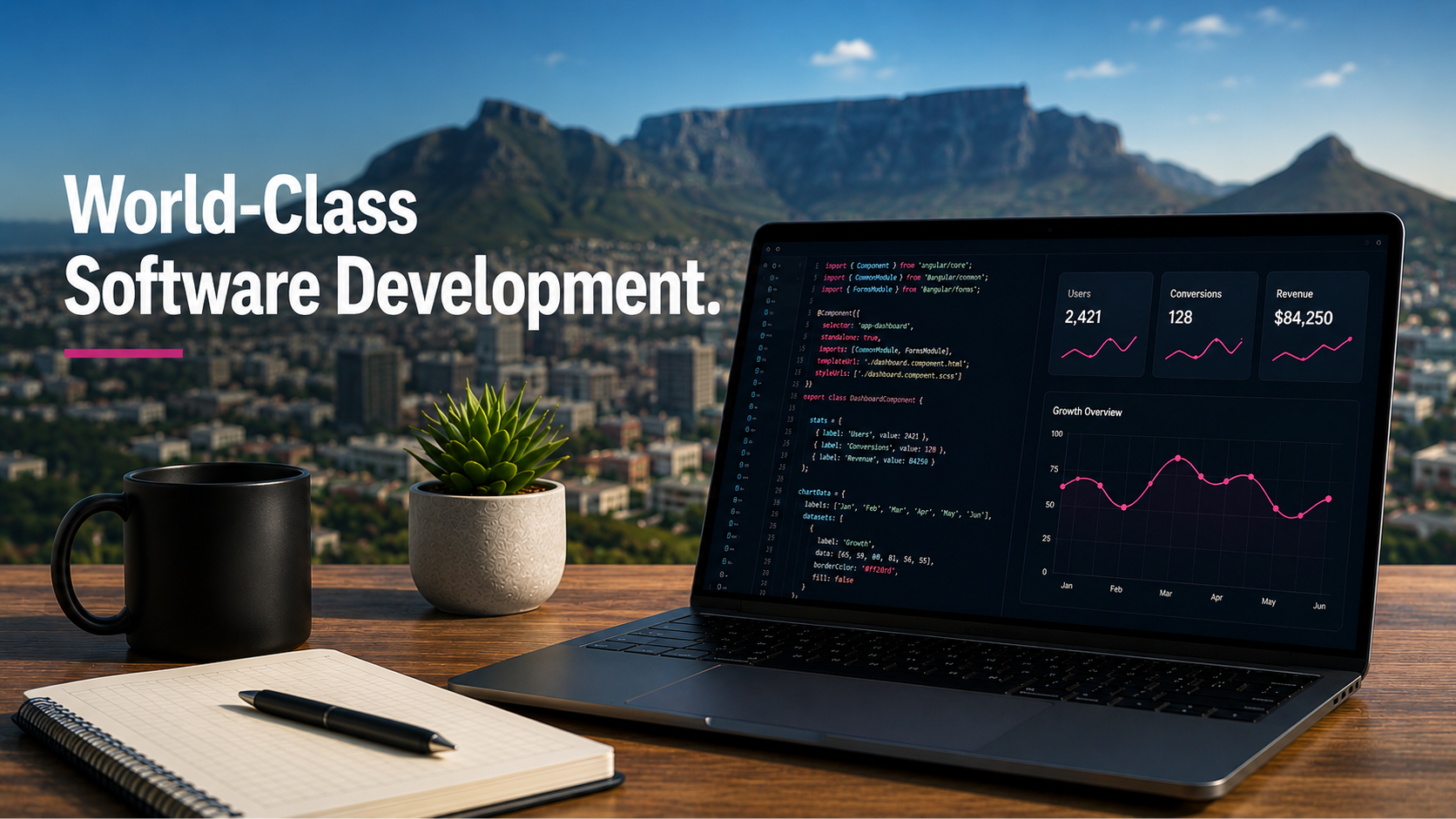
Every outsourcing destination has real strengths, and none of them is universally "better." The question is which combination of strengths actually fits what an agency needs.
India offers enormous scale and highly competitive pricing, which is exactly why it's become the default choice for large, cost-sensitive projects. Eastern Europe built its reputation on strong engineering fundamentals, though rising rates over the past few years have changed the economics for a lot of agencies who once treated it as the budget-friendly option. Latin America offers geographic proximity and closer time zone alignment for US companies, which matters for teams that need heavy daytime overlap.
None of that makes any of these markets wrong. It just means the decision shouldn't default to "whichever market I've already heard of." It should be based on communication, engineering quality, collaboration style, strategic input, and long-term fit. Evaluated on those terms, South Africa deserves a seat at that table, not as a replacement for the familiar options, but as a genuine alternative most agencies have simply never priced out.
The Hidden Cost of Choosing on Price Alone
Plenty of agencies have a bad outsourcing story. Almost all of those stories start the same way: they chose the cheapest option on the table.
The sticker price looks great right up until the first missed deadline. Then it's technical debt nobody flagged early. Then it's code quality that only becomes visible once someone else has to maintain it. Then it's a frustrated client asking hard questions, and eventually an expensive rewrite that costs more than doing it properly the first time would have.
The cheapest partner often becomes the most expensive decision an agency makes that year, just not on the invoice you can see up front. That's why "value" and "cheap" are different conversations, and why a quality-first, value-focused destination is a fundamentally different pitch than a race-to-the-bottom one.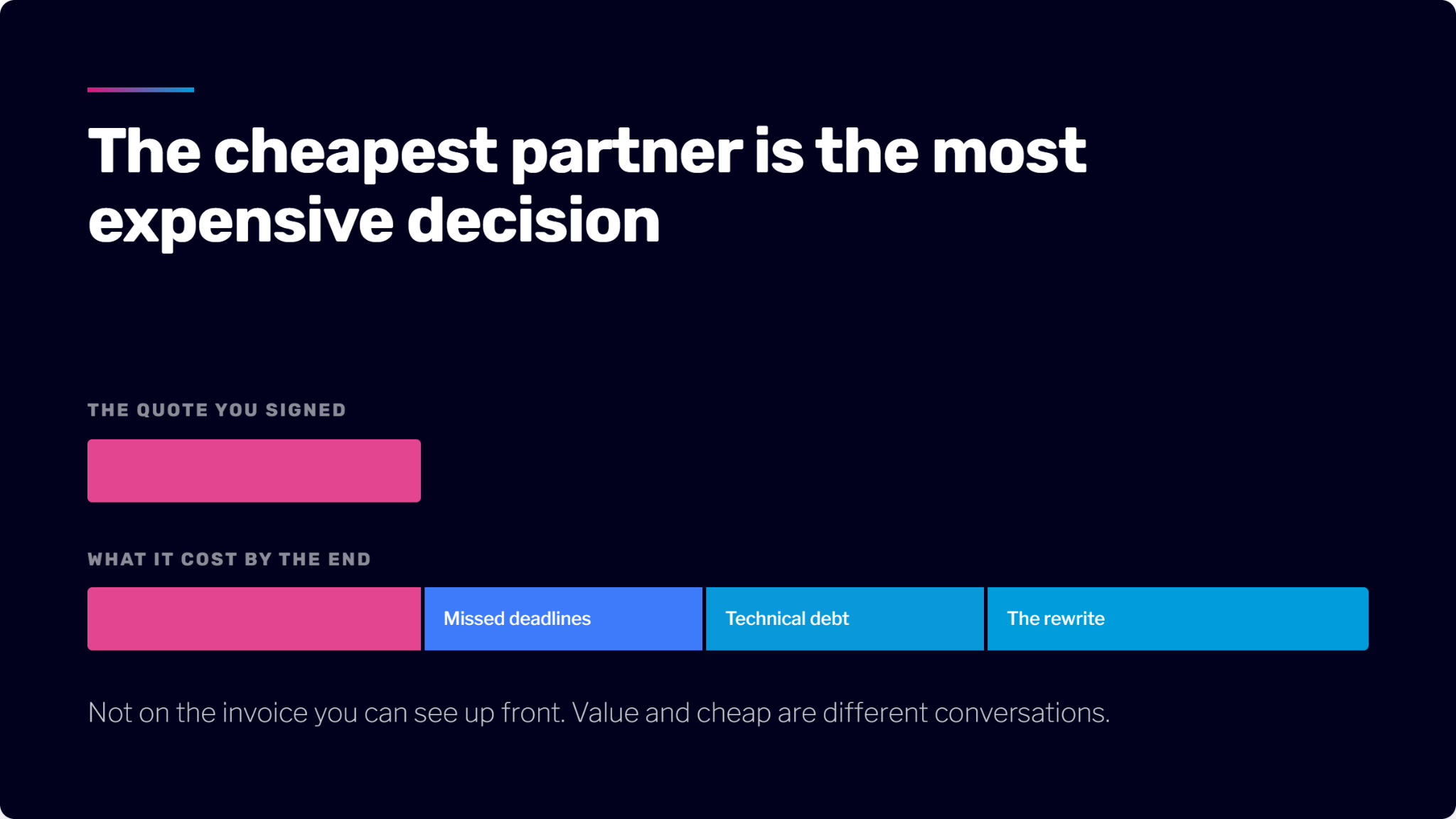
What Great Agency Partnerships Actually Look Like
Strip away the marketing language and a genuinely great technical partner does a specific, definable set of things:
- Communicates clearly, in real time, without a translation layer slowing things down.
- Thinks strategically, contributing to scope and architecture decisions rather than just executing tickets.
- Delivers engineering quality that doesn't need to be quietly rebuilt six months later.
- Shows stability, meaning the same team and the same institutional knowledge stick around project to project.
- Fits culturally, which shows up in small things like tone, responsiveness, and how disagreements get handled.
- Operates transparently, so there are no surprises buried in a status update three weeks from now.
- Commits for the long term, treating the relationship as a partnership rather than a single transaction.
Challenging ideas constructively. Flagging risk early. Helping scope a project properly instead of just quoting whatever's asked for. Advising on architecture before it's too late to change course. Thinking commercially about what actually protects the agency's relationship with its client. Integrating into the existing delivery team so well that, from the client's side, it feels like one team, not two.
That's the bar. It's a high one, and it's the bar South Africa's best teams are built to clear.
Why South Africa Is Still an Untapped Competitive Advantage
Most agencies are still looking exactly where every other agency is looking. The well-known outsourcing destinations are well known precisely because everyone already knows about them, which means everyone's already priced them, tested them, and in a lot of cases, gotten burned by the same issues everyone else has run into.
The most interesting opportunities are usually found where fewer people are paying attention. South Africa gives agencies a chance to access genuinely capable engineering talent before that market becomes as saturated and commoditised as the more established ones. That's not just a development destination. That's a competitive advantage, available right now, to whichever agencies are willing to look a little further than the obvious shortlist.
A Sensible Way to Test It
None of this requires a leap of faith. The lowest-risk way to evaluate any new development partner, South African or otherwise, is with a small, well-scoped pilot project rather than a full commitment on the strength of an article.
A single feature build, a defined module, or a fixed-scope project gives an agency a real, low-stakes way to see how a partner communicates, how they handle scope changes, and what their code actually looks like once someone else has to read it. If it goes well, it's the natural start of a longer relationship. If it doesn't, the exposure was small. That's a far more sensible test than committing a major client engagement to an unfamiliar partner on day one.
A Brief Word About Elemental
For more than 20 years, Elemental has helped organisations across South Africa, the UK, Europe, and the United States design, build, and support custom digital platforms, delivering hundreds of projects with an in-house team that's stayed together and grown over that time.
We don't see ourselves as an outsourced development team. We see ourselves as a long-term technical partner that becomes an extension of the businesses we work with. Whether we're supporting an agency behind the scenes on delivery or collaborating directly with stakeholders on strategy and scope, the goal is the same: build software that strengthens the relationship it's built for, not just the codebase it runs on.
The Smartest Agencies Are Already Looking
The agencies that thrive over the next decade won't necessarily be the ones with the largest teams. They'll be the ones that build the smartest partnerships, the ones willing to look somewhere other than the obvious shortlist when the obvious shortlist stops delivering what it used to.
South Africa may not be the first destination that comes to mind when you think about software development. But that's exactly why it's worth taking a closer look, before everyone else does too.
If you're curious what that looks like in practice, or want to talk through a specific project, get in touch with Elemental. A short conversation is enough to find out if it's worth exploring further.
Frequently Asked Questions
Is South Africa a good destination for outsourced software development?
Yes - absolutely! South Africa has a mature software industry built around demanding sectors like banking, fintech, and telecommunications, English as a first language, and rates that are competitive with, and often better than, other established outsourcing markets. It's simply less well known internationally than destinations like India or Eastern Europe.
How many hours ahead is South Africa of the US East Coast?
South Africa is 6-7 hours ahead of US Eastern Time, depending on daylight saving. A South African team's workday overlaps with the early morning hours of the US East Coast, meaning work progresses overnight from a US perspective and is ready for review by the time the US team starts their day, with roughly two hours of live overlap for calls each morning.
Is English widely spoken in South Africa's tech industry?
Yes. English is South Africa's primary business language and the first language for most professionals in its tech and software industry, not a second language learned specifically for client work.
How does South Africa compare to India, Eastern Europe, and Latin America as an outsourcing destination?
Each region offers a different combination of strengths. India offers scale and highly competitive pricing. Eastern Europe offers strong engineering fundamentals, though costs have risen in recent years. Latin America offers closer time zone alignment with the US. South Africa offers a combination of first-language English communication, a workable time zone overlap with the US East Coast, and value-focused (rather than lowest-cost) pricing, without the market saturation of the more familiar destinations.
Does Elemental supply individual developers or take on full projects?
Full projects. Elemental takes on entire builds end to end, with our own project manager, QA process, and development team, rather than placing individual developers inside a client's or agency's existing team. That means the agency keeps the client relationship while Elemental owns delivery.
Does Elemental only work with agencies, or with businesses directly too?
We work with both. Elemental works with agencies as a white-label delivery partner and directly with businesses in South Africa, the UK, Europe, and the United States on custom platform builds.